

Dr.N.K.HETTIARACHCHI, R.L.S.S.RATHNAYAKE, A.H.I.N.CHANDRASIRI, M.G.T.G.KITHSIRI, G.A.R.WIJESINGHE
Project Abstract
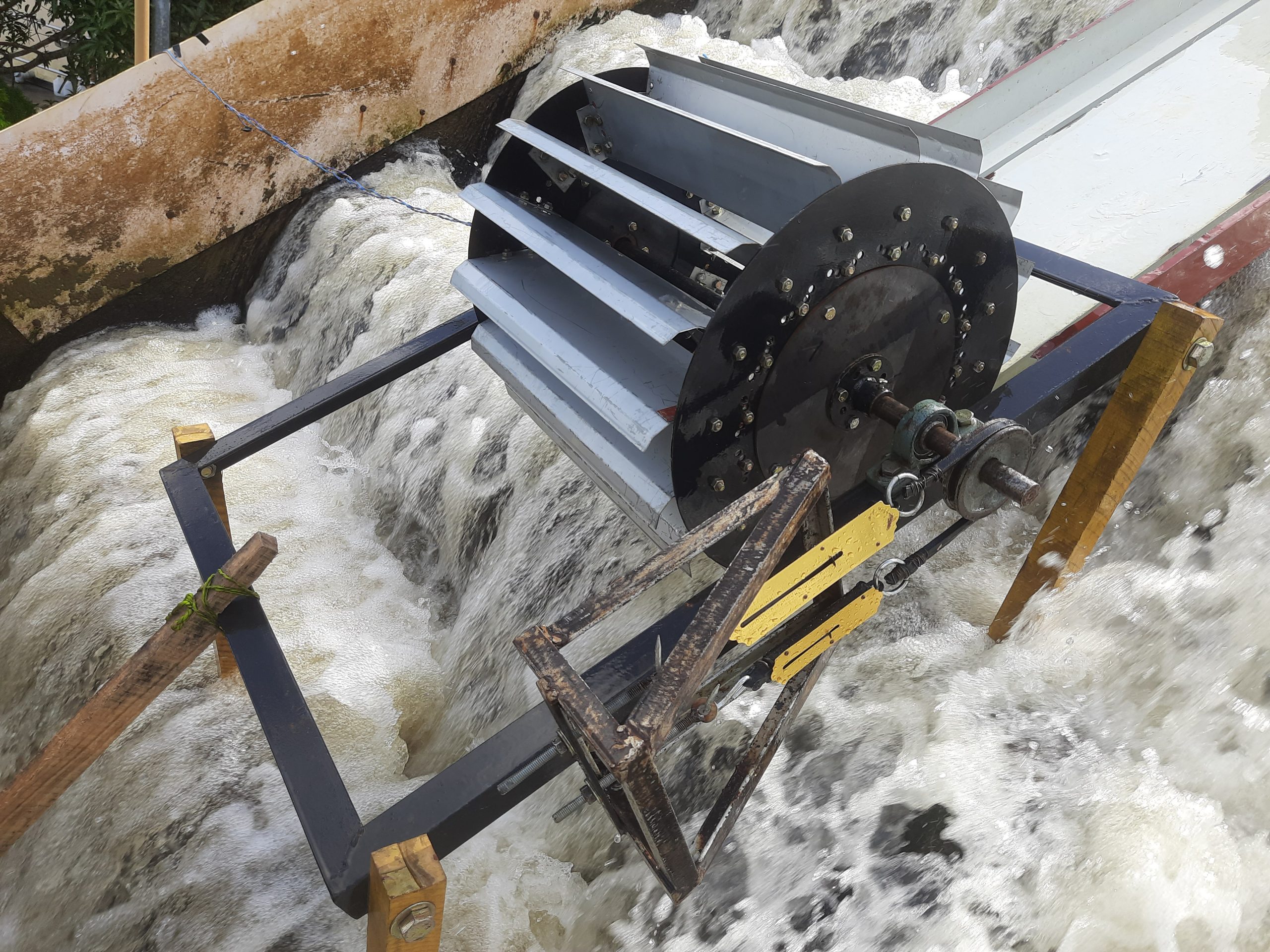
This project focuses on the modification, fabrication, and systematic testing of a water wheel turbine for low-head hydropower applications. Building upon previous iterations, the design introduces a robust torque application and measurement setup, an improved hub connection for enhanced concentricity, and an integrated alternator for power generation. The water wheel was tested under varying operational parameters—including blade angles (60°–120°), number of blades (8 and 16), and three controlled flow rates—to evaluate performance metrics such as torque, rotational speed, power output, and efficiency. Results indicate that a configuration of 16 blades at 90° under the highest flow rate yielded a maximum mechanical power of 163 W, with an estimated electrical output suitable for small-scale domestic use. The study provides a comprehensive performance dataset and design insights for optimizing water wheel turbines in similar low-head, high-flow environments, supporting renewable energy adoption in rural and off-grid settings.
Overview
The increasing global energy demand, coupled with the scarcity and environmental impact of fossil fuels, necessitates a shift toward renewable sources. Hydropower is a viable option, but extracting energy from low-head, high-flow streams remains challenging due to inefficient and poorly optimized water wheel designs. Previous iterations of this project faced critical shortcomings: a misaligned wheel causing uneven water contact, imprecise manual torque measurement, limited testing across operational variables, and no integrated power generation. These issues prevented the collection of reliable, comprehensive performance data needed to optimize water wheel efficiency and adaptability for real-world conditions.
This project directly addresses these gaps by designing and fabricating an enhanced testing apparatus that systematically evaluates water wheel performance under varying blade angles, blade numbers, and flow rates. The integration of a calibrated torque application system, an alternator for power conversion, and structural improvements ensures accurate data collection and demonstrates practical electricity generation. The resulting dataset provides a critical reference for optimizing future water wheel designs, enhancing their efficiency, durability, and site-specific applicability.
The significance of this work lies in advancing small-scale, low-head hydropower—a key untapped renewable resource in regions like Sri Lanka. By improving design precision and operational knowledge, the project supports the deployment of sustainable, community-level energy systems, reduces dependence on non-renewable power, and contributes to global efforts in clean energy innovation and accessibility.
This project successfully designed, fabricated, and tested a modular water wheel turbine system, yielding significant technical outcomes. The maximum mechanical power output achieved was 162.97 W under optimal conditions (16 blades, 90° angle, highest flow rate), with a corresponding electrical generation potential of approximately 122 W using an automotive alternator. Performance analysis revealed an efficiency of over 71% for certain configurations, and comprehensive datasets were generated across 30 distinct test setups, mapping the relationship between torque, RPM, and power for varying blade angles (60°–120°), blade numbers (8 and 16), and three controlled flow rates.
Key expected outcomes include a validated and refined testing apparatus for future research, a comprehensive performance database for optimizing low-head water wheel designs, and a demonstrated pathway for small-scale off-grid power generation capable of contributing to domestic electricity needs. The project also delivers actionable design guidelines, indicating that a 90° blade angle and higher blade count generally maximize power in high-flow conditions.
Special features of the system include a novel adjustable screw-based torque application mechanism for precise load control, a redesigned hub with a full circular steel plate to ensure perfect concentricity and eliminate wobble, and an integrated alternator mount with linear guideways for easy belt tension adjustment. The implementation of a V-belt drive solved earlier friction issues, and the customizable wooden flow-regulation system allowed for repeatable testing under three distinct flow regimes. These features collectively enhance measurement accuracy, system durability, and operational flexibility, setting a new standard for experimental rigor in micro-hydropower testing.