

Dr. K.C. Wickramasinghe, K.H.A.C. Kavindi, H.K. Shalinda, W.A.U.I.S. Wickramasingha, V. Lalith Kumar
Project Abstract
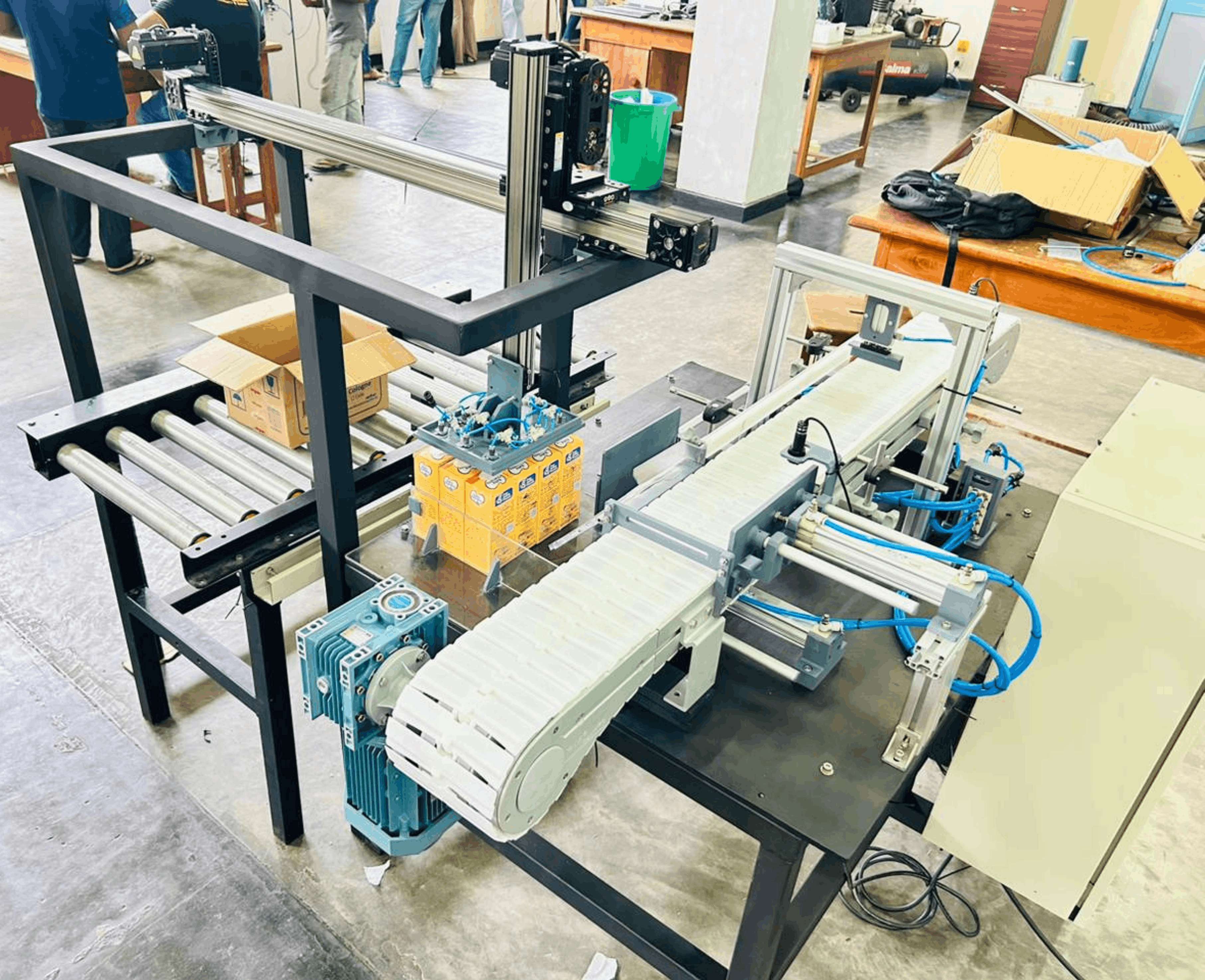
This project focuses on the design and fabrication of an automated packing-end system for the cologne production line at Hemas Manufacturing (Pvt) Ltd. The cologne packing process presents considerable challenges due to the flammable nature of the liquid and the fragility of the glass bottles. Cologne packing typically involves two primary stages: packing individual cologne bottles into carton boxes and subsequently packing carton box stacks into corrugated boxes. This project
specifically addresses the second stage, focusing on the design of a simple, efficient automated cologne line packing end machine that can be integrated into existing automated packing lines. By automating this process, the packaging workflow can be significantly optimized while maintaining compliance with industrial performance and quality standards.
Overview
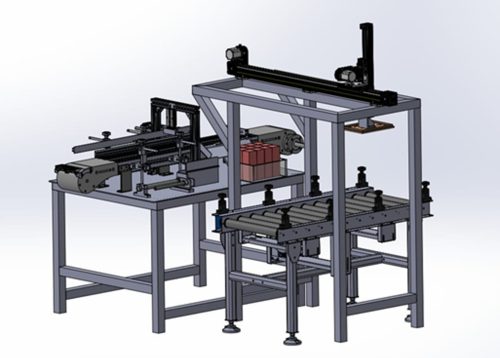
In the Hemas manufacturing (pvt) Ltd, cologne range includes 50 ml, 100 ml, and 200 ml bottles. For 50 ml and 100 ml products, a stack of 8 × 6 cartons is required per corrugated box, while the 200 ml product requires a 4 × 3 configuration. The carton boxes are available in three different sizes. The 50 ml box has dimensions of 42 mm × 42 mm × 115 mm. The 100 ml box is slightly larger, measuring 50 mm × 50 mm × 140 mm. The largest option, the 200 ml box, comes with dimensions of 60 mm × 60 mm × 170 mm. The proposed system automates several key processes currently performed manually, including carton receiving, orientation adjustment, stack formation, corrugated box forming, and pick-and-place operations. This
automated process is capable of changing the orientation of carton boxes at a rate of 60 pieces per minute without causing bubble formation inside the cologne bottles.
The automated cologne line packing-end system was successfully designed and fabricated as a functional prototype capable of handling 200 ml carton boxes. The system effectively performs carton receiving, orientation adjustment, stack formation, and pick-and-place operations with high accuracy and consistency. Experimental testing confirmed reliable stack formation without causing bubble formation inside the cologne bottles, even at increased handling speeds, demonstrating safe and product-friendly operation. The proposed automation significantly reduces manual handling, labour dependency, and human errors associated with the existing packing-end process, thereby improving overall packing efficiency and quality. The system is expected to enhance productivity, minimize operational delays, and ensure repeatable packing performance through PLC-based control and synchronized motion. A modular mechanical layout incorporating flexible conveyors, stack stoppers, angle plates, and linear actuators enables smooth and controlled carton movement. Special features include a customized 3D-printed suction pad designed for secure handling of 200 ml carton stacks, a compact and industry-compliant panel box arrangement for safe operation, and a flexible design that allows easy adaptation to multiple carton sizes with minimal adjustments.