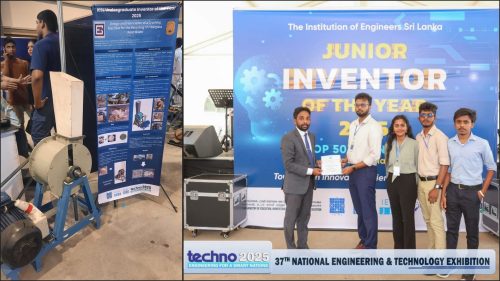
Dr. Ruwan Gallage, Fernando M.M.A, Bandara R.M.T.K, Kaushini R.M.C, Muthukelum H.D
Project Abstract
Fiberglass boat waste is an increasing environmental concern, particularly in coastal regions where disposal methods such as land filling, deep sinking, and open burning remain harmful and unsustainable. To address this issue, our project focuses on designing and developing a compact and portable mechanical crushing machine capable of converting FRP boat waste into reusable material. Using engineering principles, analytical calculations, and extensive research, we determined the required design parameters and developed a detailed 3D CAD model of the machine. Component-level simulations were carried out to validate the design, and the results closely matched the calculated values. The machine has now been fully fabricated, assembled, and tested, successfully producing the desired particle size suitable for reuse applications. This project demonstrates our technical development as engineering undergraduates and contributes to a practical, scalable, and environmentally friendly solution for managing fiberglass boat waste.
Overview
It is not easy as we think to manage fiberglass waste, where innovative recycling solutions are required despite the existing methods land-filling and dumping in the marine environment. There are numerous studies and experiments conducted throughout the world to identify better ways of recycling composite materials, but most of these methods remain underdeveloped or impractical. If we consider advanced recycling technologies, they require a large amount of capital and operational cost, which Sri Lanka won’t be able to follow since such expenses are often incurred without generating profit. Hence, what we understood is the absence of effective mechanical solutions for reducing fiberglass waste into reusable material, which has hindered the advancement of sustainable recycling practices and limited opportunities to generate value from by-products.
The significance of this project lies in developing a practical and cost-effective mechanical crushing solution for fiberglass waste recycling. While numerous crushing mechanisms exist in theory, it is essential to go beyond quantitative analysis and experience their real-world practicality. Our focus is on addressing overlooked challenges such as cost effectiveness and adaptability to different fiberglass thicknesses and compositions, and minimizing environmental and health impacts. This solution is particularly beneficial for government municipal waste management systems and local boatyards that lack proper disposal mechanisms. In addition to design and fabrication, the machine will undergo testing and validation under actual operating conditions to demonstrate its effectiveness. Ultimately, this project aims to promote environmental sustainability by reducing reliance on land-filling and marine disposal while encouraging responsible fiberglass waste recycling.
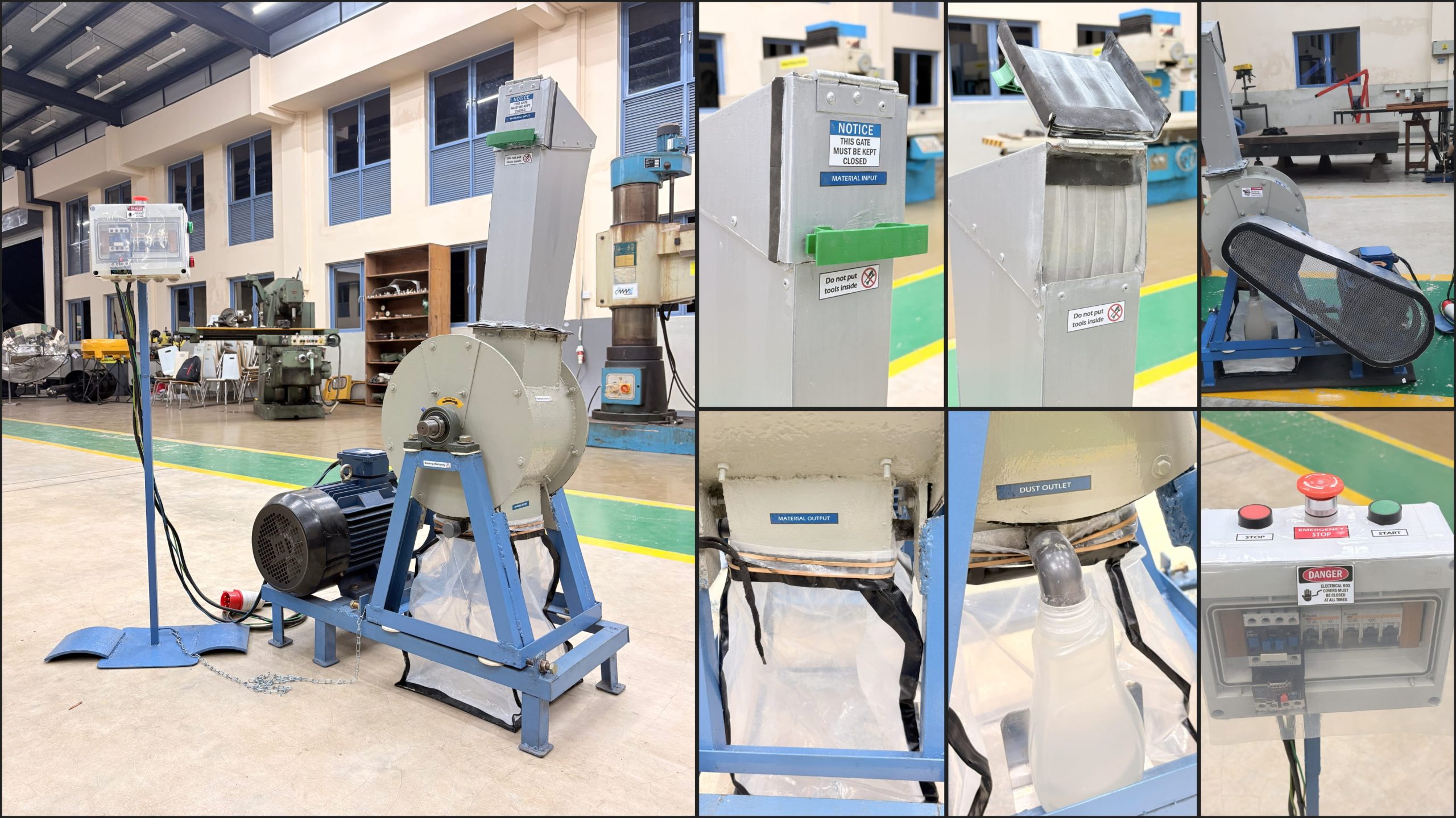
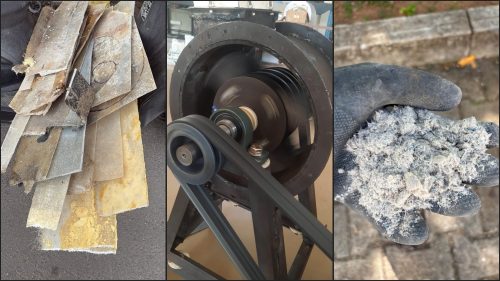
The key result of this project is the successful design, fabrication, and testing of a fully functional fiberglass crushing machine capable of handling real fiberglass boat-waste under practical operating conditions. The machine is designed to process fiberglass boat pieces with dimensions up to 100 mm × 100 mm and thicknesses up to 15 mm, which are commonly obtained from land-filling sites where boats are initially broken-down using compactors. The system is intended strictly for fiberglass-only input, without metal, wooden, or other foreign materials.
The crushing process produces powder-like fiberglass flakes with particle sizes ranging from approximately 5 mm to less than 0.075 mm. Sieve analysis results confirm that more than 75% of the crushed material, on a weight-to-weight basis, is smaller than 0.085 mm, indicating effective size reduction suitable for reuse applications. The machine operates in batch mode, powered by a 2 kW three-phase AC motor, and can process up to five pieces per batch, with a recommended crushing time of at least 10 seconds.
A fully sealed crushing chamber minimizes dust emission during operation. Minor dust release during feeding is controlled by closing the inlet gate before crushing. Since crushed particles and dust fall within similar size ranges, no separation system is used. Excess air is safely vented and directed into a water-based collection system, where dust is captured and mixed with water for potential reuse, such as in concrete-related applications. Overall, the machine offers a cost-effective and locally suitable solution designed for fiberglass boat-waste recycling in Sri Lanka.