

Mr. H.M. Supun Sanjaya, Bogamuwa KMTA, De Silva H.T.U.C., Wickramathanthri C.S, Viduranga H.A.C
Project Abstract
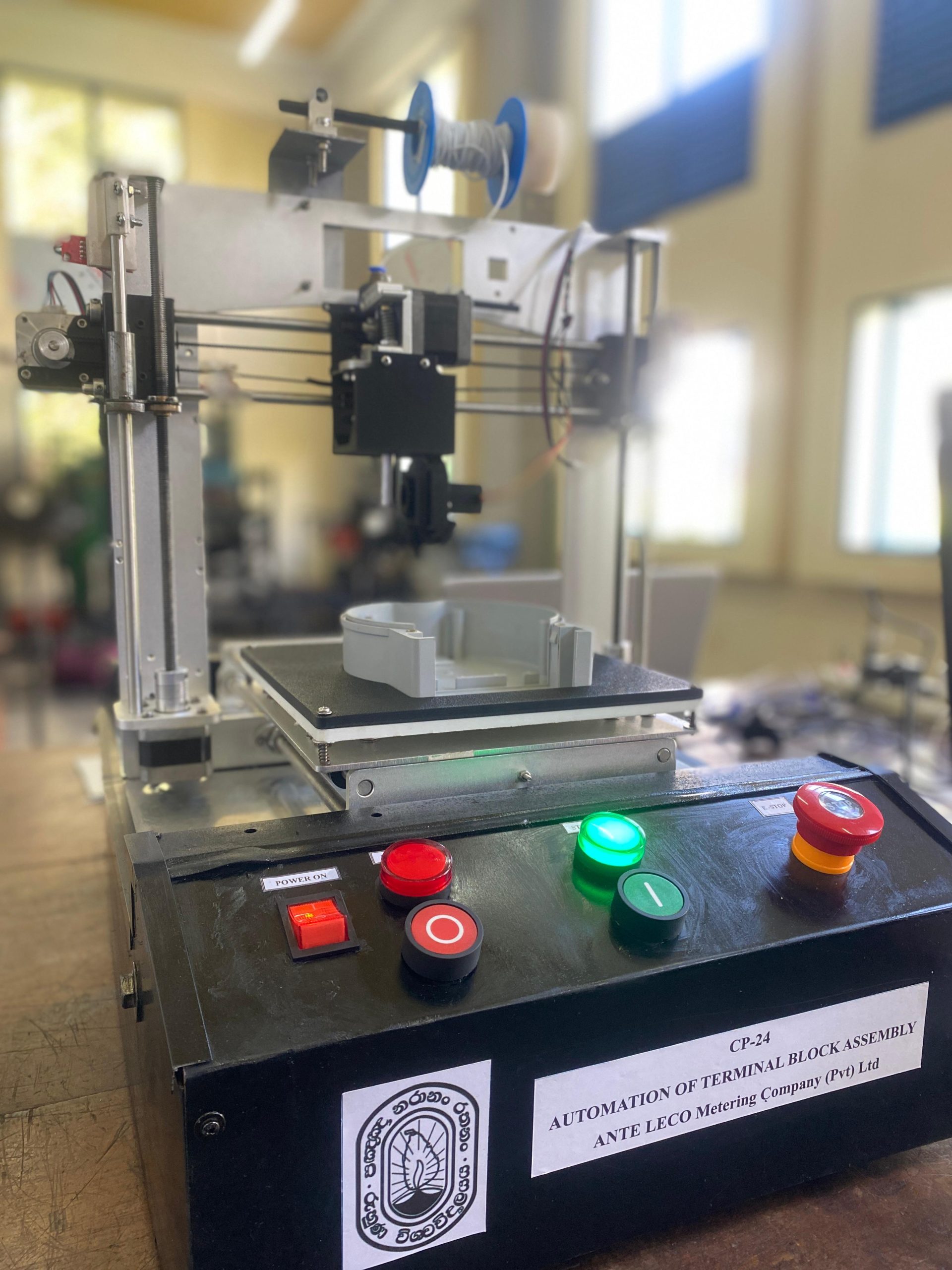
This project presents the design, development of an automated bead-laying system to replace the manual sealing bead application process used in the assembly line of Ante LECO Metering Company (Pvt) Ltd. The project aimed to improve precision, consistency, and productivity in beading meter bases and terminal blocks, tasks that are traditionally labor-intensive. The system utilizes a 3-axis gantry mechanism, controlled by a RAMPS 1.4 board with A4988 stepper motor drivers, for precise path-based positioning. The custom bead-laying tool integrates key functions: an extruder-based feeder for continuous bead delivery, a roller presser for uniform bead seating, and a gripper for cutting and holding. For terminal blocks, a stepper motor-assisted 90° rotation enables precise bead alignment at corners. Prototype fabrication and testing confirmed high positional accuracy and smooth automated operation.
Overview
The manual bead-laying process at ANTE LECO Metering Company presents significant operational challenges. Workers manually position and secure rubber beading onto terminal blocks and bases, a labor-intensive task that requires 2-4 operators and consumes approximately 16 seconds per cycle. This manual approach results in high labor costs, slow production rates, and inconsistent placement accuracy due to repetitive motion fatigue. Additionally, the process requires components to be stored for approximately one day post-injection molding before manual beading can commence, increasing work-in-progress inventory and extending overall production lead time.
The significance of this automation initiative extends beyond immediate productivity gains. With increasing demand for electricity meters both domestically and internationally, ANTE LECO is positioning itself to enter export markets, requiring scalable manufacturing solutions to meet stringent international quality standards and maintain global competitiveness. Manual processes create bottlenecks that limit production throughput and introduce quality variations that could compromise the sealing integrity of meters in field applications. The developed automation solution can be seamlessly integrated immediately after the injection molding stage, eliminating storage delays and creating a continuous production flow that significantly reduces overall manufacturing cycle time. This project addresses a critical need in Sri Lanka’s industrial sector by demonstrating feasible automation solutions for small-to-medium enterprises seeking to compete in international markets. The developed system not only solves ANTE LECO’s immediate challenges in achieving export-ready production capabilities but also serves as a reference model for similar manufacturing automation initiatives in precision assembly applications across various industries.
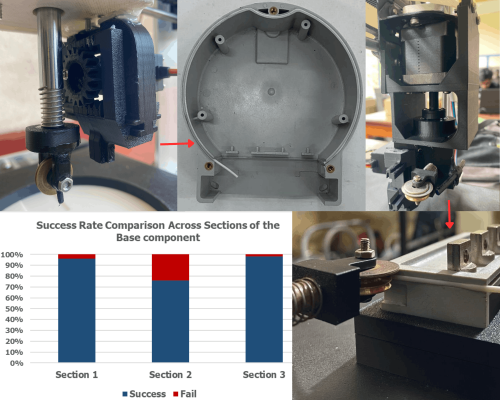
The automated system achieved a cycle time of 43 seconds for complete bead-laying operations, compared to the manual process, averaging 16-25 seconds. Despite the longer individual cycle time, the automation enables continuous operation throughout the 480-minute shift with 28,800 seconds of effective working time, eliminating tea and lunch breaks that reduce manual productivity. This results in a production capacity of 670 components per day, representing a 9.1% increase from the current manual output of 614 components. Critically, the system eliminates the one-day storage requirement between injection molding and bead-laying, enabling direct process integration. Repeatability testing across 50 cycles of base component demonstrated success rates of 85-95% depending on geometric complexity, with straight-path sections achieving near-perfect consistency, validating the system’s reliability for industrial deployment
Three-Axis Gantry System: Provides precise Cartesian positioning with stepper motor-driven motion control, achieving positional accuracy suitable for industrial applications
Custom Bead-Laying Tool: Iteratively developed tools incorporating brass rollers, spring-loaded compliance mechanisms , and adaptive pressure application for consistent bead seating
Rotational Capability: Terminal block tool features an integrated stepper motor for 90-degree rotations, enabling accurate corner navigation
Rack-and-Pinion mechanism based Gripper: Advanced gripping mechanism ensures 100% bead retention during cutting operations, eliminating material slippage
Modular Design: System accommodates various component geometries through programmable paths and adjustable fixtures. The modular design permits future enhancements, including dual-tool implementation for doubled throughput, force sensing integration, and vision-guided adaptation, positioning the system for continuous improvement in export-oriented high-volume production environments.