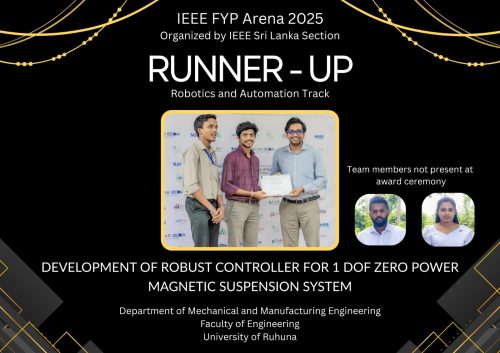
Dr. Buddhika Annasiwaththa, Dinendra S.M.S., Muthukumarana P.M., Ilangarathna I.P.R.R., Hewawasam H.E.T.S.
Project Abstract
Thrust bearings are often used in different industrial applications with varying axial
loads. Despite those use cases, these conventional thrust bearings are incorporated with unclean
operating environments making it challenging to use in controlled industrial environments where
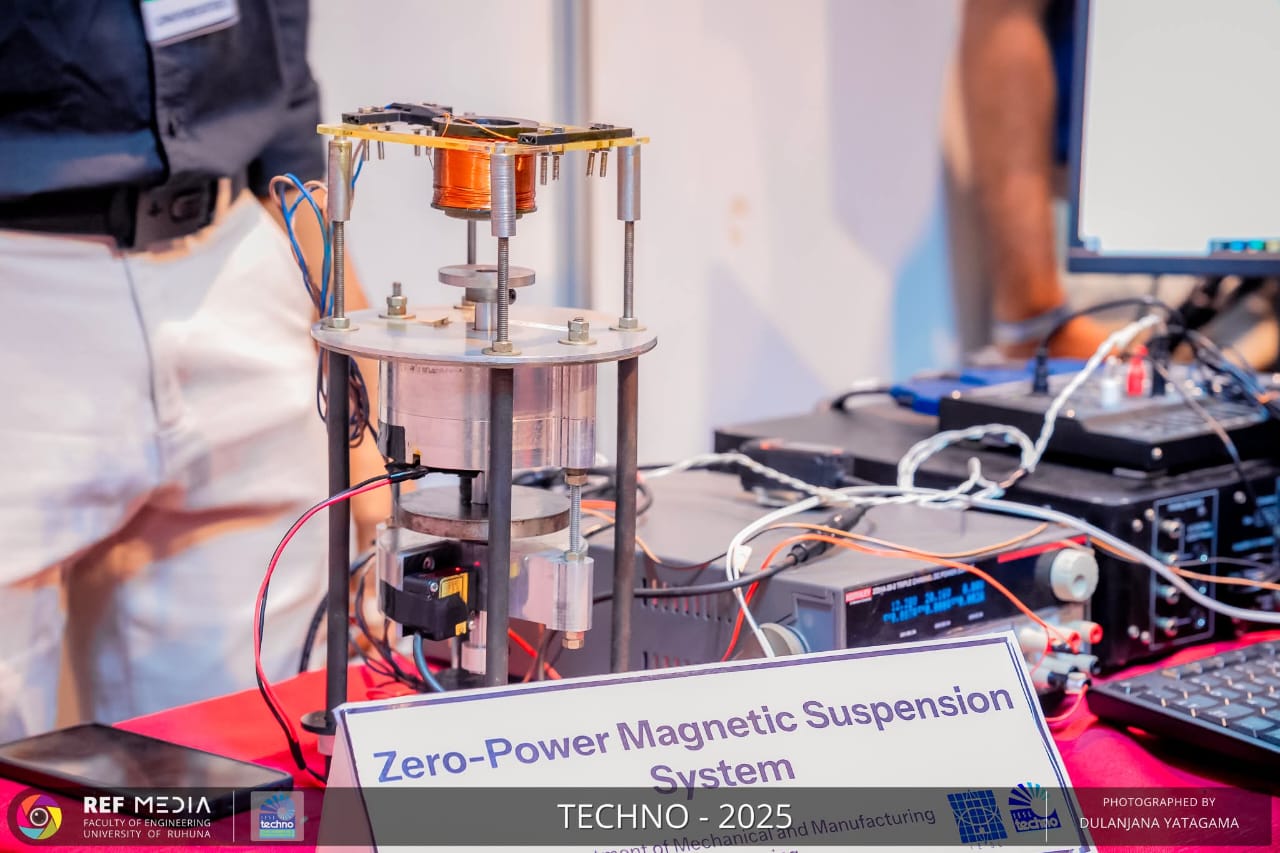
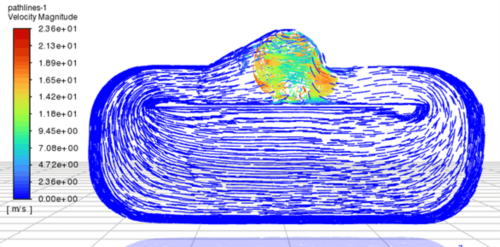
environmental cleanliness is a pivotal factor. This study has been done to develop a 1 degree of freedom magnetic suspension system equivalent to a vertical thrust bearing using an active robust controller with a hybrid electromagnet which can perform disturbance rejection and encounter model uncertainties. A finite element analysis has been performed to identify the properties of the hybrid electromagnet under varying parameters. The electrical system has been modelled as a RL circuit while a computer aided design of the mechanical system has been developed to analyze and validate the performance prior to the implementation in real system. The H∞ robust controller has been developed using the mathematical model of the system which was developed along with system analysis. Later the developed controller was validated under known external disturbances and model variations and plotted the system behavior. The results have showed the ability of the controller to reject external disturbances comparing to the performance of PID controller under same conditions.
Overview
Since a long period of time, the thrust bearings have played a crucial role in mechanical engineering applications due to their ability to handle varying axial loads. Despite their excellent abilities, these conventional thrust bearings are incorporated with unclean operating environments due to the use of lubricants such as oil and grease, dust particles and other metal powder. Also, these bearings bring sound pollution to the environment due to metal-to-metal contact within the components. Considering all these factors, using conventional thrust bearings in industries such as semiconductor fabrication under controlled environments have become a serious challenge where environmental cleanliness is pivotal factor. In order to satisfy this need, magnetic bearings powered by electromagnets have been started to use in such industrial applications for quite a period of time. Although these magnetic bearings eliminate the previously mentioned issues compared to conventional bearings, applying them directly is not an easy task. With all the uncertainties and varying conditions, controlling the magnetic field is a challenging task. Especially for vertical thrust bearings with varying loads. Several studies have been carried out using simple control techniques such as PID controllers to stabilize such systems. Although they can operate under optimal conditions, they lack the ability to withstand system uncertainties and external disturbances which could occur when operating in real world
systems. Therefore, the need of a system with a controller which can perform disturbance rejection is a timely concern. In this study, a robust controller which can perform above tasks has been developed for a 1 degree of freedom (DoF) magnetic suspension system equivalent to a vertical thrust bearing. A hybrid electromagnet (HEM) has been used, which consists of a permanent magnet and an electromagnet. The primary force has been generated by the permanent magnet while it has been controlled using the voltage supply of the electromagnet. The shaft and the shaft plate have been stabilized in the mid-air, while maintaining a constant air gap. The system has been running as a closed loop control loop where the air gap distance and the current flow in the electromagnet has been the system feedback. Using the developed robust controller, this study has successfully been able to drive the system to zero power state during the steady state operation under external disturbances and model parameter variations. Also, the study provides a comparative analysis on system performance with simple PID control under the
same operating conditions.
Current variation under H∞ Control vs PID Control
PID controlled system has shown a higher response with a larger overshoot compared to H∞
controlled system. But the PID controller has
brought the system to steady state faster than the
H∞ controller proving its tracking ability. With a
smaller overshoot the robust controller has
brought the system to zero power steady state
slowly.
(Appendix A)